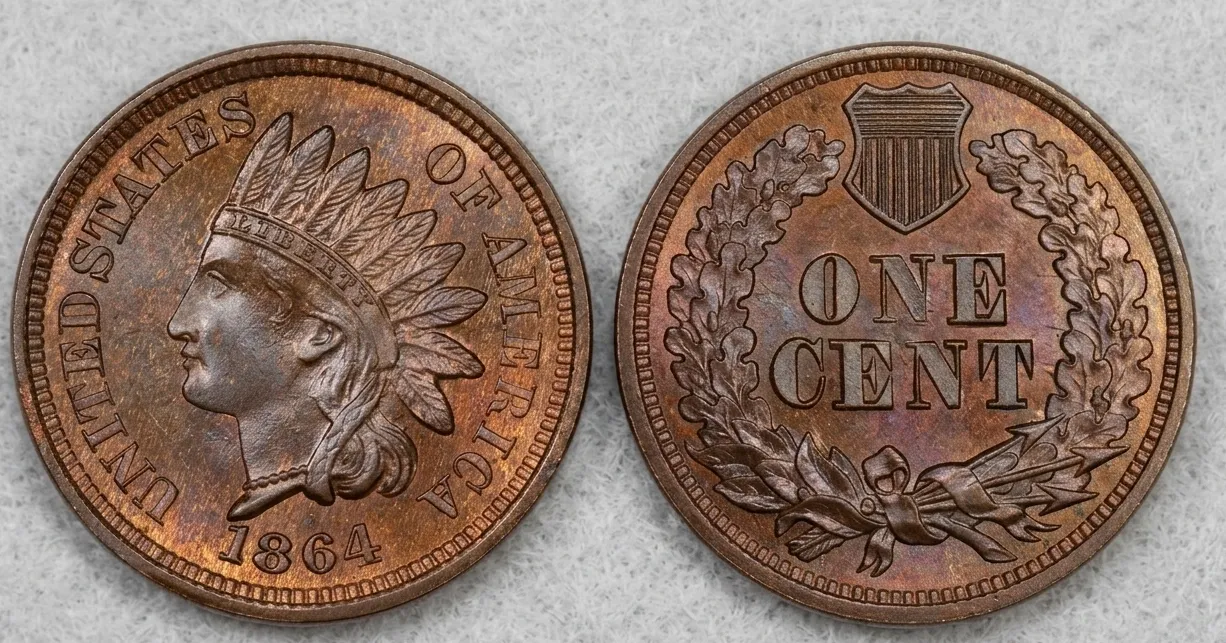
Production shifts during the final stages of the American Civil War created three distinct versions of the 1864 cent.
Identifying these 1864 Indian Head Penny variations requires precise measurements and an understanding of mid-19th-century minting changes.
Primary Technical Specifications by Type
| Specification | Nickel-Copper Version | Bronze Version |
| Metal Mix | 88% Copper, 12% Nickel | 95% Copper, 5% Tin/Zinc |
| Mass | 4.67 grams | 3.11 grams |
| Edge Thickness | 1.70 mm | 1.45 mm |
| Diameter | 19.00 mm | 19.05 mm |
| Total Mintage | 13,740,000 units | 39,233,714 units |
| G-4 Market Price | $18 | $12 |
| MS-63 Market Price | $195 | $215 |
Logic Behind the Metal Transition
Rising costs of raw materials forced a reduction in coin weight to maintain production volume.
High market prices for nickel caused a significant shortage at the minting facilities.
Citizens hoarding the thicker nickel-copper coins removed them from general circulation almost immediately.
Legal mandates signed on April 22, 1864, established the lighter bronze standard for future coinage.
Reducing the total weight allowed the Mint to produce more units from the same supply of copper.
Detection Workflow: Categorizing Your Specimen
Accurate categorization eliminates the risk of mispricing a rare asset.
- Weight Verification
Heavy coins exceeding 4.6 grams → Nickel-Copper Alloy Light coins near 3.1 grams → Bronze Alloy
- Visual Color Assessment
Pale yellow or greyish tint → Nickel content present Deep brown or reddish tone → Bronze alloy
- Measurement via Calipers
Thicker vertical edge → Old standard design
Or simply use the free coin scanner.
The “L” on Ribbon: Identifying the Apex Rarity
Chief Engraver James Longacre added his last initial to the design late in the production year.
This specific modification appears exclusively on the lighter bronze specimens.
Finding the initial requires looking at the pointed ribbon tail hanging behind the ear.
Factors Driving Exceptional Market Value for the “L” Type
Scarcity remains the primary driver as only a fraction of the total mintage features this mark.
Strike quality on the initial correlates directly with final hammer prices.
Heavy wear often erases the “L” before other design elements disappear.
Spotting traces of the initial on low-grade coins provides a significant value multiplier.
Record sales for an 1864-L in MS-66 Red condition reached $161,000 at Heritage Auctions.
Investment-grade specimens in Proof 65 or higher show a 5% annual appreciation rate as of 2026.
Value Progression by Sheldon Scale Grades
Pricing follows a strict hierarchy based on professional certification levels.
Certified grades provide the necessary security for high-stakes transactions.
- F-12 (Fine) Category
Nickel-Copper: $45
Bronze: $38
Bronze with L: $140
- EF-40 (Extremely Fine) Category
Nickel-Copper: $95
Bronze: $90
Bronze with L: $420
- MS-65 (Mint State) Category
Nickel-Copper: $850
Bronze: $1,150
Bronze with L: $8,500
Engineering Deviations in Die Design
Shifts in metal density required James Longacre to adjust the depth and sharp edges of the dies.
- Ribbon Tip Sharpness
Nickel-Copper coins feature a blunt or rounded ribbon end. Standard Bronze coins show a more pronounced angle at the tip. The 1864-L version displays the sharpest point to accommodate the engraved initial.
- Feather Detail Levels
Lower feathers on the headdress appear less defined on nickel-copper strikes. Bronze versions allow for deeper penetration of the die, revealing fine barb details.
- Rim Width and Height
High rims on nickel-copper coins protected the central portrait from friction. Thinner bronze planchets required a wider, flatter rim to ensure proper metal flow.
2026 Market Supply Analysis
Inventory levels for top-tier 1864 cents continue to decline across major exchanges.
Institutional buyers consistently remove high-grade examples from the public market.
Distribution of surviving specimens by quality tier: MS-60 and above → less than 2% of the surviving population XF-40 to AU-58 → roughly 12% of known coins VG-8 to VF-30 → the bulk of the market at 86%
Annual growth for the MS-65 Red sub-sector has averaged 5.2% over the last decade.
Demand for Red-Brown (RB) surfaces remains high due to their natural appearance.
Manufacturing Defects and Mint Errors
Specific anomalies from the 1864 production run command significant premiums.
Double Die strikes on the front side occur with extreme rarity.
Off-center strikes appear more frequently on the lighter bronze planchets.
Die cracks running through the words ONE CENT do not typically lower the grade.
Mechanical damage like scratches or cleaning reduces value by 60% to 80% regardless of type — see it via a free coin appraisal app.
Investment Forecast and Risk Management
Acquiring numismatic assets requires a long-term perspective on historical significance.
1864 remains a “Key Date” for anyone attempting to complete a full series.
Buying uncertified coins carries a high risk of encountering altered specimens.
Advancements in tool technology allow for the fraudulent application of an “L” initial.
Microscopic inspection of the initial’s angle helps distinguish genuine strikes from fakes.
Recent Auction Performance Statistics
Public records show 412 successful sales of various 1864 types over the last 24 months.
Average prices for AU-55 grade specimens sit near $215.
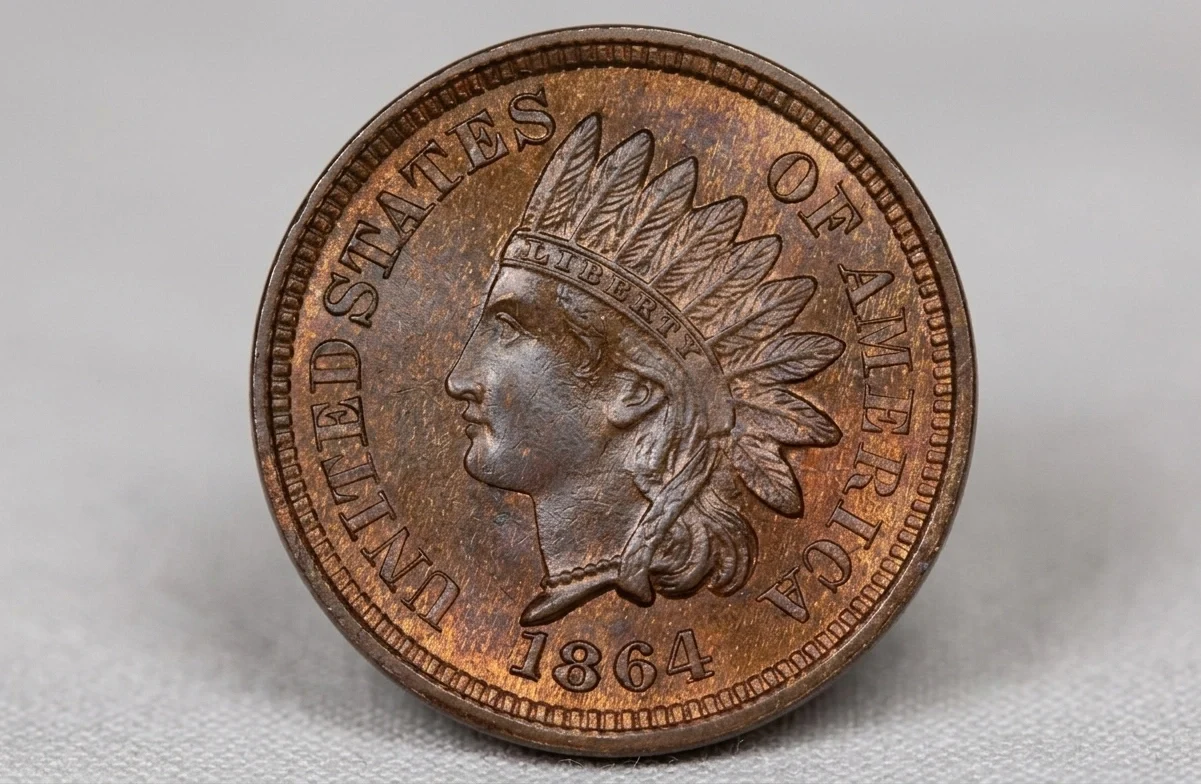
Price spreads within a single grade reach 30% based on the quality of the patina.
Natural chocolate-brown surfaces fetch higher prices than cleaned or spotted coins.
Using chemical cleaners destroys approximately 90% of a coin’s premium value.
Impact of the Civil War on Minting Consistency
Ongoing military conflicts disrupted the logistics of metal procurement.
Naval blockades prevented the easy arrival of tin and zinc needed for the bronze mix.
Using varying copper sources explains the wide range of colors found in 1864 bronze coins.
Certain specimens exhibit a “Woodgrain” texture on the surface.
Incomplete mixing of the molten metal before rolling the sheets causes this effect.
Final Classification
Navigating the market requires a clear understanding of the rarity ladder.
- 1864-L Proof — The pinnacle of rarity and price
- 1864-L MS-65+ — Prime investment-grade material
- 1864 Nickel-Copper MS-65 — Peak condition for the heavy type
- 1864 Bronze MS-65 — Common type in flawless condition
- 1864 Nickel-Copper (Circulated) — Entry-level historical asset
- 1864 Bronze (Circulated) — High-volume collector material
Evaluating each coin based on these physical metrics ensures accurate valuation.
Every detail from mass to the microscopic initial dictates the final transaction price.
Patience during the authentication process prevents significant capital loss.
Price stability for 1864 Indian Head Pennies remains high after decades of tracking.
Professional catalogs serve as mandatory references for anyone operating in this space.